

All About the Little-Known Grey Snake

The Grey snake is one of the most elusive members of the Elapidae snake family.
As they tend to forage on the ground between dusk and dawn, they have only been witnessed a handful of times over the past 65 years.
Like other Elapids, such as the Eastern brown snake, the Grey snake is venomous. In this article, we will uncover all the mysteries of the Grey snake and teach you how to manage their bites.
To learn more about identifying, treating, and preventing snake bites, enrol in one of our general or childcare first aid courses.
We have training locations in every state, capital city, and major town throughout Australia - head to our website to enrol at a training location near you today.
The Grey snake (Hemiaspis damelii) has the following identifying characteristics:
Though not much is known about the Grey snake's distribution, existing records indicate they are commonly found in south-eastern Queensland and north-central New South Wales.
Small populations have also been found in south-western New South Wales and north-eastern South Australia.
They tend to shelter in cracking clay soils and under rocks, logs, and other debris in woodlands and dry sclerophyll forests where water bodies are present.
The Grey snake is mostly active during the night. They use this time to hunt and feed on frogs and skinks.
They are currently listed as endangered under the Environment Protection and Biodiversity Conservation Act 1999.
There are several factors contributing to their population decline:
The Grey snake has fairly mild venom that is unlikely to cause human fatalities.
However, their venom contains procoagulants and can cause local pain and swelling.
All snake bites should be treated as a medical emergency:
It is important to remember, snakes will never go out of their way to attack you. The best way to avoid a snake bite is to refrain from approaching, capturing, or killing any snakes at home or in the wild. If you need a snake relocated from your property, contact a professional snake catcher.
For hands-on experience with identifying, treating, and preventing snake bites, enrol in one of our general of childcare first aid courses.
We have training locations in every state, capital city, and major town throughout Australia.
Head to our website to find and enrol in a training location near you today.

April 7, 2023
Darwin and the wider Top End region of the Northern Territory is home to over 40 native snake species. It this article, we help you decrease your risk of a snake bite by uncovering the main identifying characteristics of seven of Darwin's most common snake species.
April 7, 2023
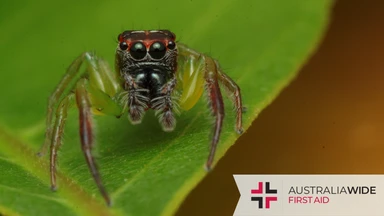
The Green Jumping Spider is the largest jumping spider found in Australia. They have been known to venture into urban areas, where they feed on insects and other spiders. They have deceptively large fangs that can inflict painful bites in humans.
April 5, 2023
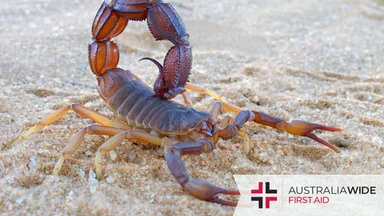
Though we are renowned for our wide variety of venomous snakes and spiders, Australia is also home to more than 100 species of scorpions. And while they typically live in remote habitats, they have been known to enter homes and inflict painful stings.